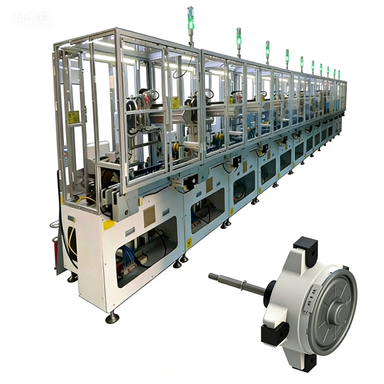
Brushless DC motors, commonly known as BLDC motors, have become an important part of modern electrical and mechanical systems. They are widely used in electric vehicles, industrial automation, cooling equipment, robotics, drones, household appliances and many other applications where efficient and reliable motor performance is required. As demand for these motors continues to grow, manufacturers need production equipment that can create accurate and consistent windings at a practical speed. This is where bldc motor winding machines play an important role.
Winding is one of the most critical stages in BLDC motor production. The arrangement, number and positioning of copper coils directly influence the motor’s efficiency, torque, speed and operating temperature. Even relatively small differences in winding quality can affect the final performance of a motor. Modern winding machines therefore combine mechanical precision, electronic control and automation to produce consistent coils and stator assemblies.
Understanding BLDC Motor Winding
A BLDC motor uses permanent magnets on its rotor and electrically energised windings on its stator. Unlike a traditional brushed DC motor, it does not use mechanical brushes and a commutator to switch current. Electronic controls perform the switching instead, allowing the motor to operate efficiently with reduced mechanical wear.
The stator winding creates the magnetic field that interacts with the permanent magnets in the rotor. For this reason, the winding pattern must match the electrical design of the motor. The number of slots, poles, phases and turns can all influence the required winding arrangement.
During production, copper wire is wound into the stator slots according to a defined pattern. The machine must control factors such as wire tension, winding speed, coil position and the number of turns. If these variables are inconsistent, the motor may show differences in resistance, inductance, torque or efficiency.
Modern equipment helps manufacturers control these variables more accurately. Instead of depending entirely on manual winding, automated machinery can follow programmed winding patterns and repeat them across large numbers of stators.
Why Winding Accuracy Matters
The quality of the winding process has a direct relationship with motor performance. Copper wire needs to be positioned properly inside the stator slots so that the available space is used efficiently. Poor positioning can create unnecessary gaps or cause wires to overlap incorrectly.
Wire tension is also important. If the tension is too low, the winding may become loose and difficult to arrange correctly. Excessive tension, on the other hand, can damage the wire or its insulation. A modern winding machine can regulate tension during operation to produce more consistent results.
The number of turns must also be accurate. A difference in the number of turns between coils can create electrical imbalance and affect motor behaviour. Automated counting and electronic control help reduce this type of variation.
Types of BLDC Motor Winding Machines
Manufacturers use different winding systems depending on the design and production requirements of the motor. The appropriate machine may depend on stator dimensions, wire diameter, slot configuration, winding pattern and production volume.
Needle winding machines are commonly suited to stators where the winding wire needs to be inserted into slots using a specialised needle mechanism. The needle moves through the stator while placing the wire according to the programmed pattern. This method can provide good control for compact and complex stator designs.
Flyer winding systems use a rotating winding element to guide the wire around the stator. These machines can achieve high winding speeds and are suitable for certain production environments where productivity is a major consideration.
Other machines are designed specifically for concentrated or distributed winding arrangements. Concentrated windings are often found in compact BLDC motor designs, while distributed arrangements can be used where the winding is spread across several stator slots.
Some modern production systems are flexible enough to support multiple winding configurations. This can be useful for manufacturers producing different motor models on the same production line.
How Automation Improves BLDC Motor Production
Automation has changed the way many electric motors are manufactured. In manual winding, operators must control wire placement and tension while counting turns and maintaining the required pattern. Although skilled workers can produce high-quality results, the process can be time-consuming and may introduce variation.
Automated bldc motor winding machines can perform these operations with programmed parameters. The equipment can control winding speed, wire tension, turns and movement according to the selected production recipe.
Repeatability is one of the biggest benefits. Once the machine has been correctly configured, it can produce multiple stators with similar winding characteristics. This helps manufacturers maintain consistent product quality and makes large-scale production more practical.
Automation can also improve productivity. A machine can carry out repetitive winding operations continuously, reducing the time required for each stator. Operators can then focus on machine supervision, quality checks, material preparation and maintenance.
The Importance of Wire Handling
Copper wire is relatively delicate, particularly when small diameters are used. During winding, the wire must pass through guides and around components without unnecessary friction or sharp bending.
A well-designed winding machine includes systems for controlled wire feeding. Guides and tension mechanisms help keep the wire moving smoothly while maintaining the required tension. If the wire is pulled too strongly or becomes tangled, production quality can suffer.
Wire insulation must also be protected. Scratches or damage to the insulation can create electrical problems after the motor is assembled. For this reason, winding equipment should be designed to minimise contact with sharp edges and other surfaces that could damage the conductor.
Modern machines may include wire-break detection and other monitoring functions. If the wire breaks or the process moves outside a defined condition, the system can stop or alert the operator. This can prevent defective stators from progressing to later manufacturing stages.
Quality Control After Winding
Winding quality should be checked before the stator moves to final assembly. Visual inspection can identify obvious problems such as incorrectly positioned wires, damaged insulation or inconsistent coil shapes.
Electrical testing provides additional information. Manufacturers may measure winding resistance to confirm that coils have been produced consistently. Differences between phases can indicate an issue with winding, connections or materials.
Inductance and other electrical characteristics may also be checked depending on the motor design. Automated test equipment can compare measured results with defined limits and identify units that require further inspection.
For larger production facilities, test data can be recorded digitally. This allows manufacturers to track quality over time and identify patterns. If a particular winding machine begins producing more deviations, maintenance teams can investigate the equipment before the problem affects a larger quantity of motors.
Choosing the Right Winding Equipment
Selecting suitable bldc motor winding machines requires an understanding of the manufacturer’s actual production requirements. The motor’s stator dimensions, slot design, wire diameter and winding pattern should be considered before selecting equipment.
Production volume is another major factor. A manufacturer producing thousands of identical motors may benefit from highly automated equipment designed for speed and repeatability. A smaller producer making several motor designs may need a more flexible machine that can be adjusted between production runs.
Machine control systems are also important. Modern equipment may use programmable controls that allow operators to save different winding recipes. This can simplify production when multiple motor models are manufactured.
Maintenance and technical support should not be overlooked. Winding machines contain moving parts, control systems and wire-handling components that require regular inspection. Easy access to replacement parts and technical assistance can help minimise production downtime.
Applications of BLDC Motors
The growing use of BLDC motors is one reason demand for efficient winding equipment continues to increase. In electric mobility, BLDC technology can be used in various compact and high-efficiency drive systems. In industrial automation, these motors can provide precise and reliable movement.
They are also used in cooling fans, pumps, compressors and household appliances. Their brushless construction can offer advantages such as reduced mechanical wear and efficient operation.
In robotics and drones, compact BLDC motors are particularly valuable because designers often need high power relative to motor size. Producing these motors consistently requires accurate stator winding and careful quality control.
The characteristics required by each application can differ considerably. A motor designed for a small fan may have very different winding requirements from one intended for an industrial actuator or mobility system. Flexible manufacturing equipment can therefore be valuable for companies serving multiple markets.
The Future of BLDC Winding Technology
BLDC motor manufacturing is moving towards greater automation, data collection and process monitoring. Future winding systems are likely to provide more detailed information about wire tension, winding position, production speed and other parameters.
Smart manufacturing systems can use this data to identify process deviations and support predictive maintenance. Instead of waiting for a machine component to fail, manufacturers may be able to identify unusual operating behaviour and schedule maintenance earlier.
Robotic handling and automated inspection may also become more common. These technologies can reduce repetitive manual work while improving production consistency.
At the same time, manufacturers will continue looking for ways to reduce material waste and energy consumption. More accurate winding can help make better use of copper and reduce defective products, while efficient production systems can lower overall manufacturing costs.
BLDC motors are likely to remain important as industries seek compact, efficient and reliable electric drive systems. Behind their performance is a carefully controlled manufacturing process in which winding plays a central role.
By using advanced bldc motor winding machines, manufacturers can improve winding accuracy, repeatability and production efficiency. Combined with suitable materials, skilled personnel and effective testing, modern winding technology provides a strong foundation for producing dependable BLDC motors for a wide range of applications.